 Gardion
Dopamine and screens: is your kid's phone really draining their dopamine?

"Screens give kids cheap dopamine, then they crash, and everything else feels boring." You'll find some version of this in parenting articles, school newsletters and videos about "dopamine detox." Neuroscience doesn't describe a crash like that. Cartoons don't use up dopamine, and games don't burn it out. The brain uses dopamine to flag that something is worth doing again. Kids do get cranky and bored after screen time, but the reasons are simpler: something fun stopped in the middle, they're tired, and the next activity hasn't started yet. We pulled together what research says about dopamine and screens, where scientists still disagree, and what you can do as a parent. Whether phone addiction in kids is a real condition is covered in the main article of this series.
Where the "dopamine crash" idea comes from
There's no diagnosis or scientific term by that name. It comes from pop psychology and usually means feeling flat and unmotivated after something exciting. In search suggestions, it shows up next to "after vacation" and "after a trip," so kids and phones are only part of the story.
The closest thing to a scientific basis is a model from Anna Lembke, a Stanford psychiatrist who treats addiction. In her book *Dopamine Nation*, she describes how frequent, intense rewards lead the brain to turn down dopamine signaling, so ordinary pleasures start to feel dull. She calls this a chronic dopamine-deficit state. The model hangs together, and it's easy to see why it caught on. But it grew out of work with patients in an addiction clinic. We found no measurements showing that kind of deficit in an ordinary child after cartoons or games.
"Fast" and "slow" dopamine are another pop-science image, and we haven't come across them in research papers. There's one dopamine. A short video and a solved math problem don't produce two different kinds.
What dopamine actually does
Dopamine is a chemical messenger that nerve cells use to signal each other. It plays a part in motivation, learning and the sense of reward. It's also needed for movement: in Parkinson's disease, brain cells don't make enough dopamine, and moving becomes hard.
For a long time, scientists assumed dopamine *was* pleasure. In 1998, neuroscientists Kent Berridge and Terry Robinson removed almost all the dopamine from rats' brains and gave them something sweet. The rats still reacted to sugar as pleasant. What they lost was the drive to work for a reward. Since then, researchers have separated "wanting" from "liking." Dopamine does much of the work behind wanting, and liking doesn't depend on it.
So do screens release dopamine? Yes, the way any activity with a goal and a payoff does. That same year, British researchers scanned the brains of adults playing a tank game for a cash prize and saw dopamine being released. It was one of the first times anyone had observed dopamine release during an everyday human activity. In our view, the release by itself says nothing about harm: the brain puts out dopamine whenever we anticipate something and go after it.
Five claims about dopamine and screens
We collected statements that keep turning up in articles about kids and devices and checked each one against the research.
Gaming disorder, and how it differs from a hobby, is the subject of our article on gaming disorder in teens. Our guide to short attention span in kids checks another common claim: that short videos ruin kids' attention.
| What you'll read | What's known |
|---|---|
| Phones give kids a "dopamine crash" | No such condition exists in medicine. The closest model describes patients with addiction, and nobody has measured it in typical kids |
| A dopamine detox "resets" the brain | Avoiding fun doesn't lower dopamine levels, and nothing gets replenished in the meantime (Harvard Health, 2020) |
| Games hit the brain like a drug | Gaming releases dopamine, like any activity with a reward. Gaming disorder is real, but it's a diagnosis with specific criteria, made by a clinician |
| There's "fast" and "slow" dopamine | There's one chemical. Neuroscience has no such split; it's a metaphor from blogs |
| Phones are rewiring kids' brains | Large studies don't show this. Scientists still argue about social media, and there's no data on "rewiring" |
What brain scans of teens show
In 2016, psychologists at UCLA showed teens their own photos in an MRI scanner, each with a different number of likes. The researchers assigned the likes themselves. The more approval a photo seemed to get, the more active the nucleus accumbens became, a part of the brain's reward system. The authors note that this system is especially sensitive during adolescence.
In 2023, another team scanned the brains of North Carolina students once a year for three years. The first scans took place when the kids were in seventh grade. In those who checked social media many times a day, the brain's sensitivity to anticipated approval from peers changed differently from everyone else's. The authors say they can't tell the cause: the platforms, or differences the kids already had. Whether those changes are harmful isn't known either. Whether social media harms teens at all is still debated. We cover both sides in our article on social media and teen anxiety.
We also found results pointing the other way. The U.S. ABCD study compared screen time in kids aged 9 to 12 with how their brains work. It found no link to problems, and over two years, screens had no effect on brain maturation. Psychologist Candice Odgers, reviewing the question for *Nature* in 2024, writes that there's no evidence platforms are "rewiring" kids' brains, while still calling on the platforms to change.
We see two takeaways for parents. A teen's brain responds strongly to approval, and feeds are built to use that, so screen time and feed settings are worth talking about. But the research gives no reason to think your child's brain is damaged. The brain keeps maturing into the mid-to-late twenties and stays very good at adapting the whole time. How feeds keep attention locked in is covered in our article on doomscrolling in teens.
Why kids get angry when screen time ends
The American Academy of Pediatrics explains this with dopamine too, just without the crash. Pediatrician Jenny Radesky writes that while a child is playing or watching something fun, the brain releases dopamine, and when the activity stops, dopamine drops. That's an ordinary dip after something enjoyable. We adults feel it too, when someone pulls us away from a movie at the tensest moment. Getting cut off mid-level and being tired at the end of the day add to it.
If turning off the screen ends in screaming every time, take a look at our article on tantrums when you take the phone away: it covers what to say in that moment.
A predictable handoff helps:
- Before screen time starts, say how long it will last and what comes next.
- Let your child set the timer themselves. Radesky suggests this for kids who do well with warnings.
- Agree that they can finish the episode or level they're on. The next one doesn't start.
- Afterward, offer something else they enjoy. Radesky calls this "trading up."
- Talk about the rules later, once everyone has calmed down.
Does your child need a dopamine detox?
The method was coined by California psychiatrist Cameron Sepah. Writing for Harvard Health in 2020, physician Peter Grinspoon explains that Sepah meant it as a technique from cognitive behavioral therapy: step away for a while from the things that keep pulling at you, like notifications and messages. As it spread, the idea turned into giving up everything enjoyable. Grinspoon puts it plainly: this kind of fasting has very little to do with either fasting or dopamine. Abstaining doesn't lower dopamine levels, and no reserves get recharged.
We'd keep the first part for families: fewer notifications and a set place where the phone goes in the evening. We see no point in taking away all of a child's fun for the sake of dopamine. How to take a break from screens together is covered in our article on a digital detox for teens.
When your teen says "my dopamine is fried"
We wouldn't argue with the phrase. Ask your teen what they mean by it. It can cover very different things: they can't get started on homework after videos, they have no energy, they slept badly, or they've felt down for weeks.
The first few usually respond to sleep, movement and a steadier routine. The last one sounds more like low mood: talk with your teen, and consider bringing in their doctor or a mental health professional. Signs that are worth worrying about are collected in our article on signs of phone addiction.
Screen breaks with exercises in Gardion
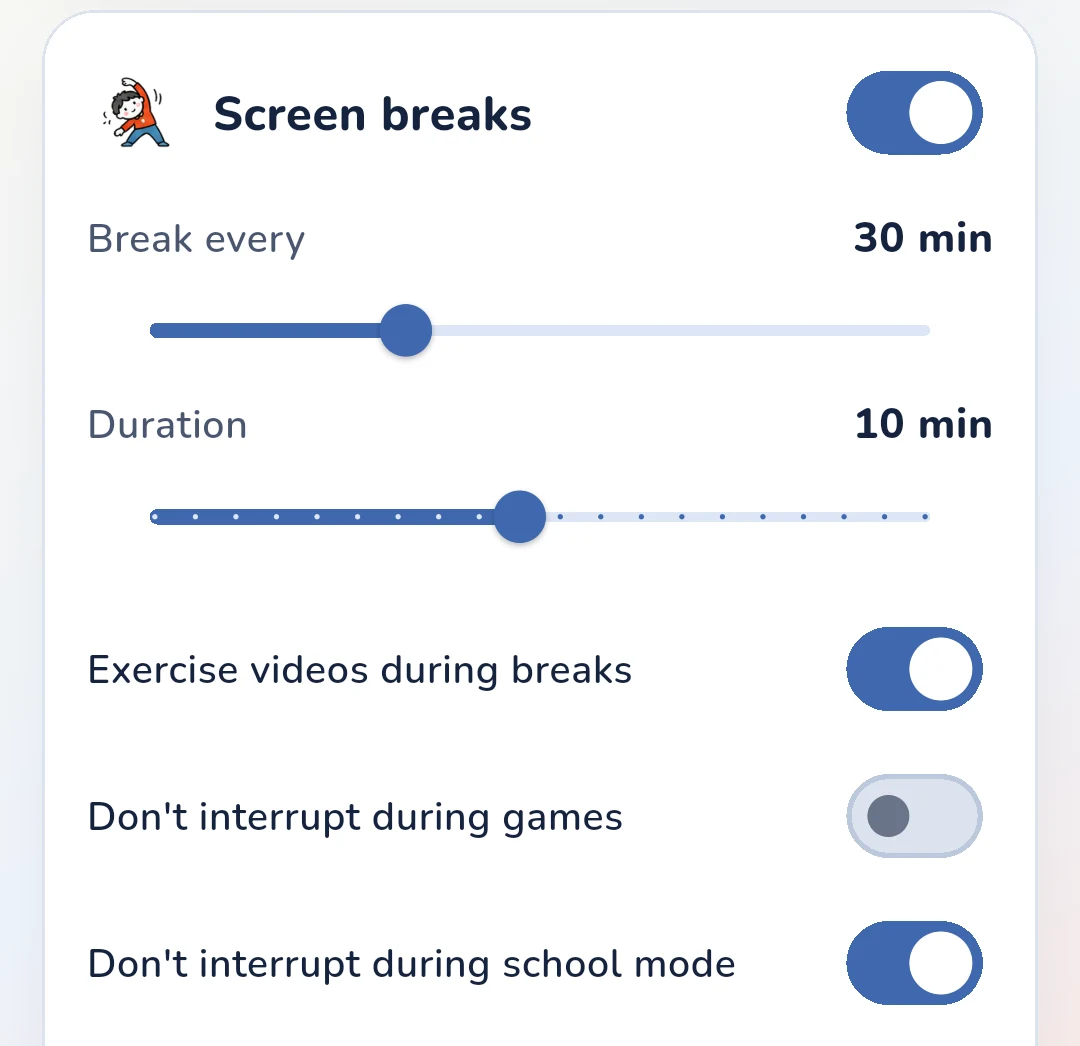
Gardion is a parental control app. We built screen breaks into it to make stepping away from the screen easier. You choose how many minutes of screen time come before a break and how long the break lasts. When the break starts, an exercise opens on top of the game: a knight demonstrates a stretch, your child copies it and earns a star. Stars can be traded for rewards you set. If a break in the middle of a game gets in the way, you can turn breaks off during games and during school mode.
For age-based guidelines, use our screen time by age calculator. Installing Gardion on your kid's phone is shown on the parental controls for Android page.
About two minutes before a break, your child sees a message on screen: "Break coming soon — wrap up."
Sources
Links checked October 19, 2026.
Peter Grinspoon, Harvard Health Publishing: Dopamine fasting: Misunderstanding science spawns a maladaptive fad, February 26, 2020.
K. C. Berridge, T. E. Robinson: What is the role of dopamine in reward: hedonic impact, reward learning, or incentive salience?, Brain Research Reviews, 1998.
M. J. Koepp et al.: Evidence for striatal dopamine release during a video game, Nature, 1998.
Stanford Medicine: Addictive potential of social media, explained, interview with Anna Lembke, October 29, 2021.
L. E. Sherman et al.: Social media "likes" impact teens' brains and behavior, Psychological Science, 2016.
M. T. Maza et al.: Association of Habitual Checking Behaviors on Social Media With Longitudinal Functional Brain Development, JAMA Pediatrics, 2023.
J. Miller et al.: Impact of digital screen media activity on functional brain organization in late childhood: Evidence from the ABCD study, Cortex, 2023.
Candice Odgers: The great rewiring, Nature, March 29, 2024.
Jenny Radesky, American Academy of Pediatrics: Screen Time and Temper Tantrums: Helpful Tips for Parents, 2024.
MedlinePlus: Parkinson's Disease.
In short
A pop-psychology name for feeling flat and bored after something exciting. There's no medical diagnosis or scientific term by that name.
The research we found doesn't show it. Screens release dopamine the way any fun activity does. Anger after screen time is explained by an ordinary dip, tiredness and being cut off mid-activity.
None; there's one chemical. The two labels come from pop science, where they contrast a short video with a long task.
If it's sluggishness after screen time, sleep, movement and a predictable handoff help: a heads-up, a timer, something fun to do next. If your child has been down for weeks, see a doctor.
Giving up everything enjoyable doesn't change dopamine levels. Agreeing on screen time and cutting extra notifications works better.
Set limits in 3 minutes
Limits, schedule and anti-bypass protection on Windows and Android. 14 days of full access, no card needed.
Try GardionOr install the parent app now.
Read next
- Phones before bed: how screens affect kids' and teens' sleepWhy phones before bed hurt kids' sleep more than adults': three ways screens interfere, how much sleep each age needs, and a screen-free last hour.
- Alternatives to screen time for kids: what to offer at the hours they reach for the phoneScreen-free activities for kids, matched to the hours they reach for the phone: a one-week plan, ideas by age, and what to do instead of screens before bed.
- Family media plan template: how to write one with your kids (with examples)A family media plan template you can copy: what to include, how to talk it through with your kids, and filled-in examples for ages 7 to 10 and for teens.
- Chore app for kids: how your child earns screen time with starsA chore app for kids that ties chores to screen time. You set a chore worth stars and check it by photo. Your child trades the stars for minutes or a reward.