 Gardion
Phones before bed: how screens affect kids' and teens' sleep

In a 2014 Japanese study, children around nine years old and adults spent the evening under the same lighting. Ordinary room light lowered melatonin, the hormone that makes us sleepy, in the children but barely changed it in the adults. That's why a phone before bed costs your child more sleep than you'd guess from your own experience. Light is only one way screens interfere with sleep. They also eat into sleep time, and games and group chats keep the brain wired. What helps is a simple routine: an hour before lights-out, the phone goes to charge outside the bedroom, and the last hour is filled with the same calm activities every night. To see how much daytime screen time fits each age, try our screen time by age calculator.
Three ways a phone cuts into sleep
We rely on a 2017 review by sleep researchers in the journal Pediatrics, which describes three mechanisms.
The first is displacement. Every half hour of videos pushes bedtime back by the same half hour. A feed or a game has no natural stopping point, so kids barely notice how long they've been on.
The second is arousal. An online match, an argument in the class group chat, or a scary video revs up the nervous system, and falling asleep is hard afterward, even in a dark room. A message that arrives at midnight wakes a child up all over again.
The third is light. A bright screen close to the eyes shifts the body clock later, so sleepiness shows up late.
Night mode warms the screen's color, which addresses only the third mechanism. The game and the group chat are still right there. That's why sleep doctors recommend taking the device itself out of the bedroom.
Why evening light hits kids harder than adults
Researchers at Kyushu University in Japan compared melatonin production in children and adults under identical conditions. Under bright light, the children's melatonin dropped far more than the adults'. Even a regular room lamp lowered it in children, while the adults' levels hardly moved. The groups were small and the authors are careful with their conclusions, but the direction is clear: a child's body responds more strongly to evening light.
The screen itself was tested on adults. In a 2015 U.S. experiment, volunteers read before bed on a light-emitting e-reader on some nights and from a printed book on others. After the e-reader, they took longer to fall asleep, had less melatonin, their body clocks ran later, and they felt less alert the next morning. If a screen does that to adults, children, with their greater sensitivity to light, are likely affected even more.
A parent who scrolls in bed and drifts off without trouble may see evening screens as harmless. Under the same light, a child has a harder time falling asleep.
Teens fall asleep later: biology plus the phone
The American Academy of Sleep Medicine explains that during adolescence both the body clock and the build-up of sleep pressure change, so teens tend to go to bed later and wake up later. At 11 p.m., a teenager may genuinely not feel tired yet.
The phone adds its own delay on top of that shift through light, the feed, and late-night texting. The school alarm still goes off at the same time, so the difference comes out of sleep. Every school night gets a little shorter.
That's why a bedtime "the same as your little brother's" won't work for a teen. A more realistic deal is to agree on when the phone leaves the room and let your teen decide when to fall asleep.
How much sleep kids and teens need
The numbers below come from a 2016 consensus statement by U.S. sleep physicians. They link ongoing sleep loss in children to problems with attention, behavior, and learning.
Count back from the alarm to find when your child should be asleep, then put the phone away an hour before that. A teen who gets up at 6:30 needs to be asleep by 10:30 to get eight hours, which means the phone leaves the room around 9:30.
| Age | Sleep per 24 hours | Keep in mind |
|---|---|---|
| 1–2 years | 11–14 hours | including naps |
| 3–5 years | 10–13 hours | including naps |
| 6–12 years | 9–12 hours | with a 7:00 a.m. wake-up, asleep by 10:00 p.m. |
| 13–18 years | 8–10 hours | with a 7:00 a.m. wake-up, asleep by 11:00 p.m. |
Where the research disagrees
The most cited review on the subject, by sleep researchers Hale and Guan in 2015, pulled together studies of school-age children and teens. In nearly all of them, more screen time went along with worse sleep: kids went to bed later and slept less. But these were observational studies. They show a link, not a cause.
In 2019, Oxford psychologist Andrew Przybylski tested that link using a parent survey covering tens of thousands of American children. Each daily hour of screen time was associated with a few minutes less sleep, and total screen time explained only a small share of the differences in sleep. His conclusion: screen time on its own has little effect on children's sleep.
We read these studies together. Hours per day is a blunt measure: it lumps an after-school cartoon together with midnight texting under the covers. Przybylski measured total daily time, and his survey can't say when the child was on the phone. A screen next to the pillow and messages at night are exactly what the three mechanisms describe and what pediatricians agree on. So we suggest starting with the last hour of the day and the bedroom. Daytime limits are a separate conversation.
A screen-free last hour before bed
The American Academy of Pediatrics, in its 2026 policy, advises no screens for an hour before bed and keeping devices out of the bedroom. The sleep medicine academy suggests 30 to 60 minutes, and Sweden's public health agency says half an hour. We go with an hour: it's easy to remember, and it leaves room for a shower, getting ready for tomorrow, and a book.
If reading doesn't take, you'll find more ideas for this hour in the bedtime section of alternatives to screen time for kids. It helps to write the rule down together in a family media plan. And if the phone keeps taking sleep away from your child, that's one of the signs of problematic use we cover in our guide to phone addiction in kids.
- Use the table above to find when your child should be asleep, and subtract an hour. That's when the phone goes on the charger.
- Pick one charging spot outside the bedroom for the whole family. A regular alarm clock can handle the wake-up.
- Dim the lights: a night-light or a desk lamp instead of the overhead light.
- Do the same things in the same order: shower, pack the backpack, then a book or a talk about the day. The American Academy of Sleep Medicine calls a consistent bedtime routine very important for children.
- Give a teen choices within the hour: a book, music from a speaker, drawing, or talking with you.
- Parents put their phones away too, at least in the child's room.
Bedtime hours in Gardion
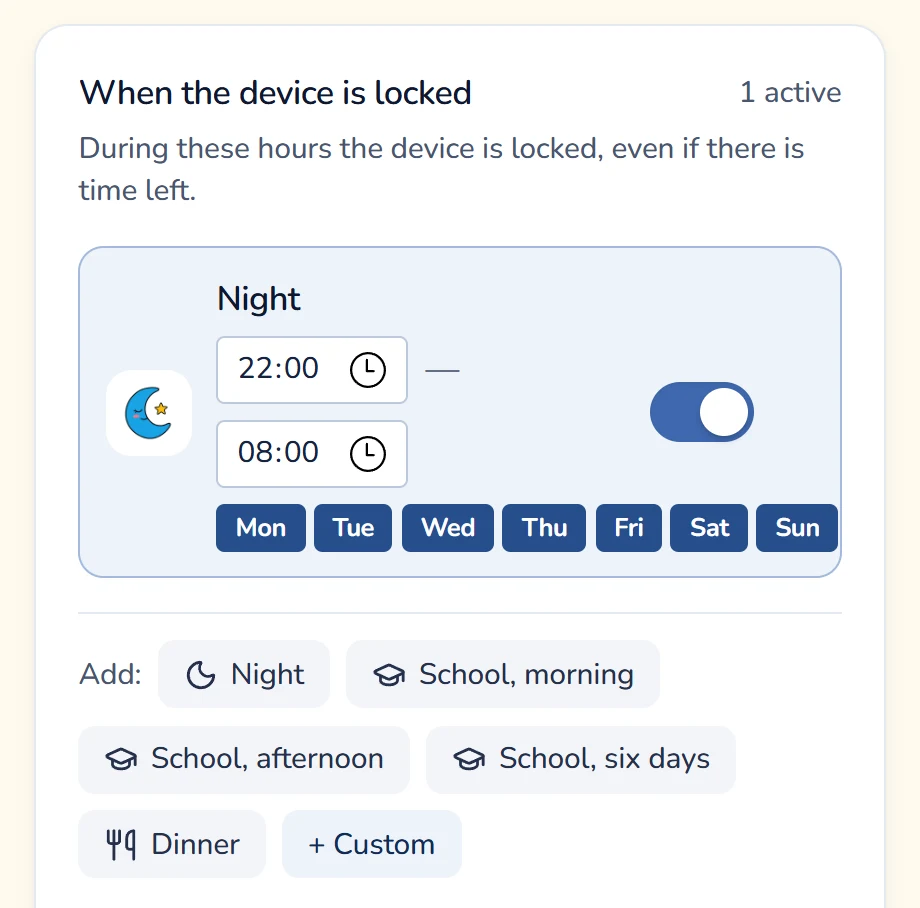
If the screen-free hour doesn't stick, Gardion can enforce it for you. In the parent dashboard, open the Time tab and go to Bedtime hours. The Night button adds a window from 22:00 to 08:00. Move the start time to the hour when, by your family's agreement, the phone leaves the bedroom. During these hours your child's device is locked, even if there's daily time left.
Calls, unlock requests, and the morning report are covered in what to do when your child is on the phone at night. If the late nights happen on a laptop, see child on the computer late at night.
Gardion works on Android phones and tablets and on Windows computers. You get full access free for the first 14 days, no card needed. Learn more about Gardion parental controls for Android.
Sources
LeBourgeois M. et al., "Digital Media and Sleep in Childhood and Adolescence," Pediatrics, 2017
American Academy of Sleep Medicine, "Recommended Amount of Sleep for Pediatric Populations," 2016
AAP News, on the policy statement "Digital Ecosystems, Children, and Adolescents," 2026
Folkhälsomyndigheten (Public Health Agency of Sweden), "Hjälp ditt barn på nätet" (in Swedish), 2024
Links checked 10/18/2026.
In short
Screens take time away from sleep, and games and chats keep the brain alert. The light also pushes the body clock later. Evening light affects children more than adults.
The American Academy of Pediatrics advises an hour, sleep physicians suggest 30 to 60 minutes, and Sweden's public health agency says half an hour. We recommend an hour and a charger outside the bedroom.
It makes the screen warmer and dimmer, so it only deals with light. The feed, the game, and the messages are all still there, which is why taking the phone out of the room works better.
On a speaker, yes: there's no glowing screen and nothing to scroll. If the sound comes from a phone, put it face down away from the bed.
Teens really do have trouble falling asleep early because their body clock runs later. Agree on when the phone leaves the room, and let your teen choose how to spend the time before sleep. If they can't fall asleep for weeks and are nodding off during the day, talk to their pediatrician.
Set limits in 3 minutes
Limits, schedule and anti-bypass protection on Windows and Android. 14 days of full access, no card needed.
Try GardionOr install the parent app now.
Read next
- Alternatives to screen time for kids: what to offer at the hours they reach for the phoneScreen-free activities for kids, matched to the hours they reach for the phone: a one-week plan, ideas by age, and what to do instead of screens before bed.
- Signs of phone addiction: when it's just a lot of screen time and when to worrySix signs of phone addiction in teens from the APA advisory, what doesn't count as a sign, what nomophobia means, and when to talk to a pediatrician.
- Phone addiction in kids: what the science says and what parents can doIs phone addiction a real diagnosis? How a habit differs from a problem and a disorder, what researchers disagree about, and what parents can do. With sources.
- Digital detox for teens and families: does it work and how to plan oneDoes a digital detox help teens? What screen-break studies found, which format fits your family, how to prepare, and what to keep afterward.