 Gardion
Digital detox for teens and families: does it work and how to plan one

A digital detox can help a teen when the whole family takes part, the break has an end date, and everyone knows ahead of time what they'll do with the freed-up hours. A day without a phone on your own does little beyond making you want it more. That's what several experiments point to. The one closest to an ordinary family ran in Denmark: parents and kids handed over their smartphones and tablets for two weeks, and by the end, parents reported fewer emotional problems in their children. Below are the experiments themselves, a table of break formats, the prep steps, and the one rule worth keeping afterward. We looked at whether "phone addiction" is real in the main article of this series.
What the screen-break experiments found
The Danish study comes closest to a family with a teenager. It included children aged 4 to 17 and their parents. A lottery decided which families got the break. Everyone gave up phones and tablets, adults included. Leisure screen use was cut to three hours a week per person, with a small allowance for things that couldn't wait: school, work, keeping in touch. According to the parents' questionnaires, after two weeks the kids had fewer emotional problems and fewer problems with peers, and they were kinder to others. A second paper from the same trial found the children moved more in their free time, while their sleep didn't change in any meaningful way.
The authors list the caveats themselves. The ratings came from parents who knew which group their family was in. Two weeks is short, and nobody knows whether the benefit lasts. The families volunteered, so they were already willing to change something.
A British study by Wilcockson and colleagues tested something else: a person seals their phone in an envelope for 24 hours, and that's the whole intervention. Mood and anxiety stayed the same. The only thing that went up was craving for the phone. Co-author David Ellis put it plainly: a short smartphone detox is unlikely to provide any health benefits.
There's a middle option too. At the University of Pennsylvania, students spent three weeks using Facebook, Instagram and Snapchat for no more than ten minutes a day per app. They ended up less lonely and less depressed than students who used social media as usual. These were college students, so the results don't automatically apply to teens. Still, the approach is worth noting: nobody quit social media, they just cut it way down.
Researchers don't agree on this. Radtke's team reviewed about two dozen detox studies, and the results went every direction: some found a benefit, some found nothing, and a few found people felt worse. The spread makes sense, since "detox" covers everything from one phone-free day to a month off a single app. Putting the studies above together, our working takeaway is this: the breaks that worked had an end date, were shared by the whole family or group, and came with a plan for the free time.
Full break or targeted rules
The same review counts any time-limited break from devices as a detox, whether it's total or covers only some activities. A week without social media and messaging apps, with calls and maps still on, qualifies. The word comes from medicine, but this isn't treatment: neither ICD-11 nor the DSM lists "phone addiction" as a diagnosis.
A full break suits teens less often than parents expect. Their phone holds the class group chat, homework, friends, and directions to practice. We'd pick a format that fits your family and your usual week.
| Format | What it looks like | Good for | Where it gets hard |
|---|---|---|---|
| Full break for a set time | Phones and tablets go in a box for the weekend or the whole trip; calls go through one shared phone | A family at a cabin, camping, on vacation | During the school week, when homework and class chats come through the phone |
| A break from one activity | A week without games or without feeds; everything else stays on | A teen whose time goes mostly to one thing | Kids drift to a similar app, so agree in advance what counts |
| Screen-free zones and hours | No phones at meals, during homework, or before bed, as the American Academy of Pediatrics recommends | Everyone, including after a longer break | It holds only as long as adults follow it too |
| A quiet day each week | One evening or one Sunday without screens for the whole family | A family not ready for a long break | It's easy to push to "next week" |
How to plan a digital detox for a teen
Announcing "starting tomorrow, no phones" on a Friday night is a reliable way to start a fight. The prep takes less time than you'd think:
- Agree on the length and the reason ahead of time. Tell them why the family wants to try it: "We want to see how we all do without screens this weekend." Opening with "you're glued to that thing" ends the conversation before it starts. The American Psychological Association advises pairing limits with conversation and giving teens more independence as they get older.
- Choose the format together. Let your teen suggest what they're willing to give up and for how many days. People stick with a plan they helped make.
- Take part yourself. In the Danish study, parents handed over their phones too. The American Academy of Pediatrics describes parents as key role models for media habits. Work email can wait for a set time and a different room.
- Decide what stays on. Calls, maps, the class chat, a banking app. The Danish families kept a small daily allowance for this kind of thing, and it didn't count as breaking the rules.
- Plan what to do with the free time. An empty evening with no plan quickly turns into an argument. We collected ideas for different ages in our article on what to do instead of a phone.
- Set an end date and a talk afterward. What was hard, what went well, and one rule the family will keep.
The first days: cravings and slip-ups
Wanting the phone on day one is expected. In Wilcockson's study, a day without a smartphone changed craving and left mood where it was. A teen who asks three times on Saturday morning where their phone is behaving like a normal person.
Try not to turn the break into a punishment. A detox handed out for a bad grade feels like a confiscation, and the teen spends the whole time thinking about how to get the phone back. If someone slips and plays a game, don't cancel the break: talk about what happened and keep going. Adults slip too, and it helps to say so out loud.
What to keep after the detox
On Monday it's easy to slide back to the old routine. We suggest taking one rule from the break that everyone liked and making it permanent. The American Academy of Pediatrics recommends three screen-free places and times: the dinner table, homework, and before bed. It also suggests reviewing the family plan at the start of the school year and during holiday breaks. Sweden's Public Health Agency adds that screens should stay out of the bedroom and go away half an hour before sleep.
Write the rule down, like a family media plan. Our screen time calculator shows how much leisure screen time experts suggest at each age. If your biggest fight is about nights, handle that one separately: what to do when your child is on the phone at night.
When a detox won't help
A break changes habits, but it doesn't treat anything. If your teen can't stop even when they want to, lies to keep the phone, and drops friends and schoolwork, compare what you see with the signs of problematic phone use and consider talking to a professional. Start with your pediatrician or a child psychologist. When long hours on the phone hide anxiety, trouble at school, or bullying, a break removes the screen and leaves the cause in place.
How Gardion helps you stick to the plan
Agreeing on a break is half the work. Watching over it all day yourself is exhausting, so Gardion puts the agreement on your child's phone.
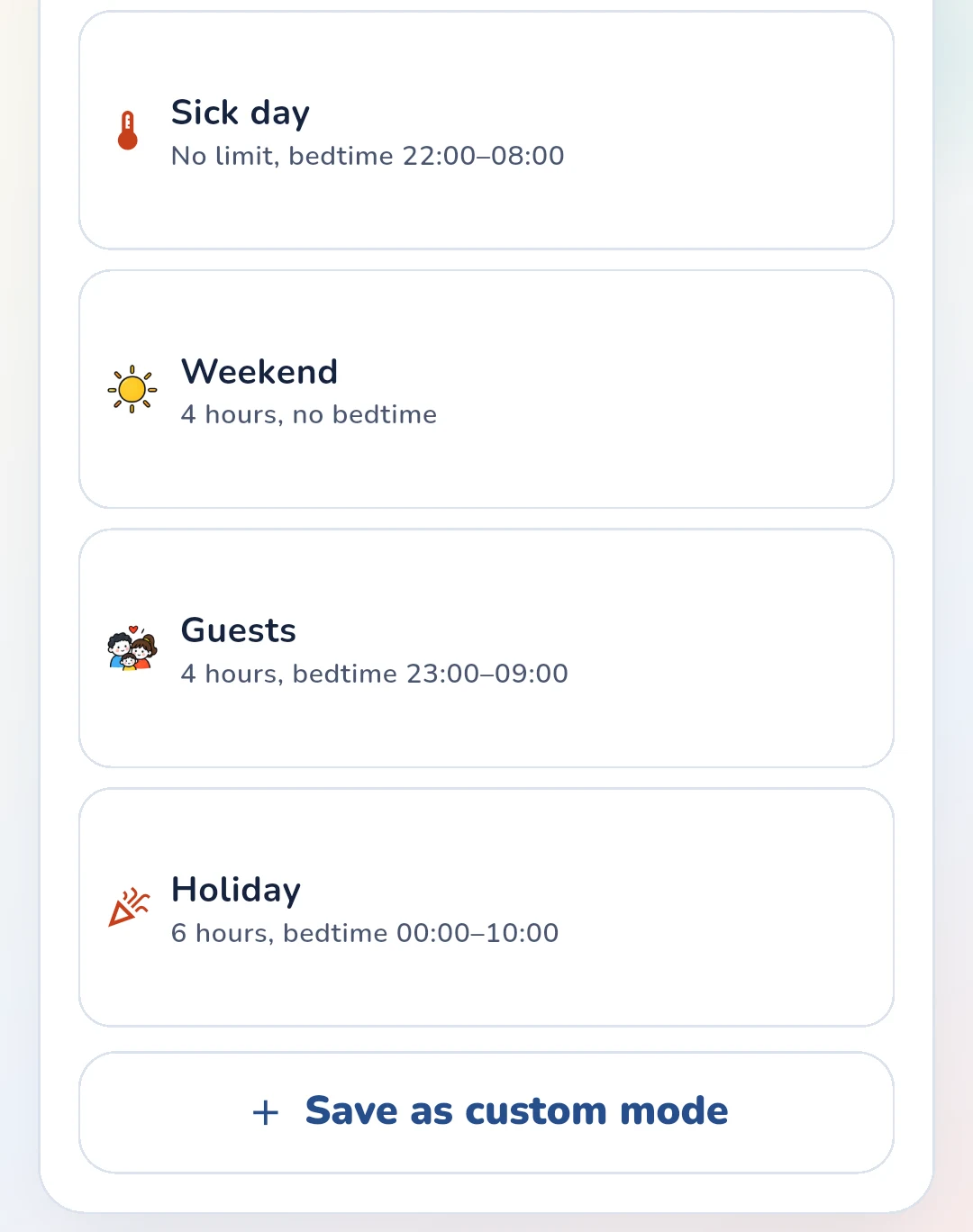
The Time tab has ready-made modes, and each one changes the limits, the night schedule, and the list of school apps in one tap. For a break, it's easier to build your own. Set a small daily limit, add hours under "When the device is locked," such as dinner and the evening, and tap "Save as custom mode." You can turn it on with one tap on Friday and switch back to your usual mode on Monday.
If the break falls during school vacation, add the dates to the "School holidays" calendar: school hours don't apply on those days, and the regular schedule comes back on its own after the last one. For a targeted detox, use group limits, which cover games, messaging apps, or video and music as a whole category. When your child really needs the phone, they tap "Ask for time," and you decide.
Gardion works on Android phones and tablets and on Windows computers. Free for 14 days with every feature, no card needed. Learn more about Gardion parental controls for Android.
Sources
Links checked October 18, 2026.
Radtke T. et al.: Digital detox: An effective solution in the smartphone era? A systematic literature review, Mobile Media & Communication, 2022.
Schmidt-Persson J. et al.: Screen Media Use and Mental Health of Children and Adolescents, JAMA Network Open, 2024.
Pedersen J. et al.: Effects of Limiting Recreational Screen Media Use on Physical Activity and Sleep in Families With Children, JAMA Pediatrics, 2022.
Wilcockson T., Osborne A., Ellis D.: Digital detox: The effect of smartphone abstinence on mood, anxiety, and craving, Addictive Behaviors, 2019.
Hunt M. et al.: No More FOMO: Limiting Social Media Decreases Loneliness and Depression, Journal of Social and Clinical Psychology, 2018.
American Academy of Pediatrics: How to Make a Family Media Use Plan, updated 2026.
Public Health Agency of Sweden: Hjälp ditt barn på nätet (in Swedish), 2026.
American Psychological Association: Health Advisory on Social Media Use in Adolescence, 2023.
In short
A break from screens for a set amount of time. It can be total or cover only some activities, such as games and feeds. For a family with a teen, it works best as a shared experiment with an end date and clear rules.
In the Danish study, two weeks without smartphones and tablets as a family reduced kids' emotional problems, according to their parents. In the British study, one day without a phone on your own changed only the craving for it. Long-term effects haven't been studied yet.
Agree on the length and the reason in advance, choose the format together, take part yourself, keep what's needed for school and staying in touch, plan what to do with the free time, and set an end date.
There's no standard length. In studies, breaks ranged from one day to several weeks. For a first try, pick something short with a clear end, like a weekend or a trip.
Yes. Otherwise a teen will read the rule as a punishment for kids. In the Danish study, adults handed over their phones as well, and the American Academy of Pediatrics describes parents as key role models for media habits.
Set limits in 3 minutes
Limits, schedule and anti-bypass protection on Windows and Android. 14 days of full access, no card needed.
Try GardionOr install the parent app now.
Read next
- Alternatives to screen time for kids: what to offer at the hours they reach for the phoneScreen-free activities for kids, matched to the hours they reach for the phone: a one-week plan, ideas by age, and what to do instead of screens before bed.
- Signs of phone addiction: when it's just a lot of screen time and when to worrySix signs of phone addiction in teens from the APA advisory, what doesn't count as a sign, what nomophobia means, and when to talk to a pediatrician.
- Phone addiction in kids: what the science says and what parents can doIs phone addiction a real diagnosis? How a habit differs from a problem and a disorder, what researchers disagree about, and what parents can do. With sources.
- How to get kids off phones: what works at 2, 5, 7, 10, and 12How to get kids off phones at ages 2, 5, 7, 10, and 12: what the WHO and pediatricians advise, house rules that work, and where an app helps.