 Gardion
Doomscrolling in teens: why the feed is so hard to put down and what helps

Doomscrolling is scrolling through bad news, upsetting videos and angry comment threads again and again, long past the point where you meant to stop. For a teen, the feed is especially hard to put down because it never reaches the bottom. In February 2026, the European Commission said in preliminary findings that TikTok's infinite scroll, autoplay and push notifications shift users' brains into "autopilot mode." Willpower alone doesn't stand much of a chance against that design. What helps is a stopping point set up in advance: autoplay turned off, notifications silenced at night, a set time for the feed, and a calm conversation at home. Below we cover what research says about doomscrolling, where scientists still disagree, what your teen can change in their own settings, and what you can do as a parent. Whether "phone addiction" is a real condition is a question we take on in the main article of this series.
What doomscrolling means
The word combines "doom" and "scroll." It describes reading one bad headline after another, each more alarming than the last, while putting the phone down gets harder.
Researchers use a tighter definition. A 2026 meta-analysis of studies on teens and adults describes doomscrolling as repeated, prolonged engagement with mostly negative or threatening content that a person finds hard to disengage from. The authors note that it overlaps with problematic social media use but treat the two as separate things.
For a parent, the practical upshot is simple: what matters is what your teen is watching and whether they can stop, more than how many hours they spend. An hour of bike repair videos looks nothing like doomscrolling. Twenty minutes of disaster clips at bedtime, followed by an hour of tossing and turning, does.
A teen's feed is rarely just news. It's short videos, arguments in the comments, clips forwarded into group chats. The upsetting stuff is mixed in with jokes and everyday posts, so from across the room you can't tell what they're actually seeing.
Why the feed is hard to put down
A book ends on its last page, and an episode ends with the credits. A feed has no end, because the next video is always loading underneath. In his 2023 advisory on social media and youth mental health, the U.S. Surgeon General listed the features platforms use to hold attention: push notifications, autoplay, infinite scroll, like counts, and recommendations built from a user's own data. He described them as designed to maximize engagement.
The European Commission went further. On February 6, 2026, it published preliminary findings from its investigation of TikTok under the EU Digital Services Act. They name the same features: infinite scroll, autoplay, push notifications and a highly personalized recommendation system. According to the Commission, constantly rewarding users with new content shifts their brains into "autopilot mode," which may lead to compulsive behavior and reduce self-control. It also found TikTok's screen-time tools easy to dismiss and not much of an obstacle. The possible fixes it mentions include phasing out infinite scroll and adding screen-time breaks, including at night. TikTok can respond, and no final decision has been made.
So when your teen "can't stop scrolling," weak character isn't the explanation. They're trying to stop in a place where the app has deliberately removed the stopping point. That's why limits decided in advance tend to work better: a setting, a time, a cap.
What doomscrolling does to the brain and mood
Search for what doomscrolling does to the brain, and you'll find plenty of scary articles about "fried dopamine." The evidence is far more cautious.
There is a link with mood. In the 2026 meta-analysis, doomscrolling was associated with anxiety, depression, psychological distress and lower well-being. But the authors rated their confidence in these findings as very low. Most of the studies measured people at a single point in time, so they can't show which comes first: anxious people seeking out bad news, or bad news making people anxious.
One study of teens did measure twice. Researchers in Turkey surveyed students aged 12 to 19 two months apart. Social media addiction at the first survey predicted doomscrolling at the second, but not the other way around. That suggests the habit of not being able to put the feed down comes first, and the anxious scrolling builds on it.
The brain claims are weaker still. The Surgeon General's advisory says some researchers believe social media can overstimulate the brain's reward system. That's a hypothesis, and the advisory presents it as one. A 2024 review in Nature goes further: the idea that phones are "rewiring" teenage brains isn't supported by the science, and most studies find no, small or mixed associations.
Our reading: there's no reason to scare your teen with talk of a damaged brain, because the data doesn't show that. But there's no reason to brush it off either. If they can't fall asleep after scrolling and walk around gloomy the next day, you don't need a study to see it.
How to stop doomscrolling: what your teen can do
Your teen can do all of this on their own in about ten minutes. We suggest going through it together, but let the phone stay in their hands.
- Turn off autoplay. In YouTube, tap your profile picture, then Settings, then Autoplay. YouTube turns autoplay off by default for users aged 13 to 17, but it's worth checking if the account was set up with an adult's birth date.
- Turn on break reminders. In YouTube, tap your profile picture, then Settings, then General, and switch on Remind me to take a break. Then pick how often.
- Silence notifications from feeds and news channels. Keep calls and messages from real people. Everything else can wait until they open the app on purpose.
- Give the feed its own time slot, say after homework, and finish at least an hour before bed. The Surgeon General advises teens to stay off phones, tablets and computers for at least an hour before bedtime and through the night.
- Charge the phone on a desk across the room. That last check before sleep is easier to skip when it means getting out of bed.
- Set app timers. On Android, the built-in Digital Wellbeing tools can do this, and we walk through them in our guide to Android Digital Wellbeing.
- If the feed starts to feel frightening, put the phone down and tell someone. The Surgeon General's advisory encourages teens to reach out to a trusted friend or adult when social media is affecting them.
What parents can do
The first impulse is to take the phone away. A study that surveyed nearly 3,000 teens twice found a link worth knowing about: when parents responded to a teen's sadness or worry with punishment, those teens later reported stronger withdrawal symptoms when they couldn't scroll. The study doesn't prove cause and effect. It doesn't make a case for punishment either.
If your teen can barely stop and is dropping homework and friends for the feed, read our guide to signs of phone addiction. If the worry comes with sleepless nights, crying, or a sense that everything is bad and will only get worse, talk to your pediatrician or a mental health professional. In the U.S., the 988 Suicide & Crisis Lifeline is available by call or text.
| What you notice | What you can do |
|---|---|
| Your teen is scrolling and getting quieter and gloomier | Ask what they're watching, and listen to the end. Save your opinion for later |
| They repeat a frightening news story | Look into it together: what's actually known and where the story came from |
| They can't fall asleep after using the phone | Agree on an hour without screens before bed and decide where the phone sleeps |
| They get angry when you ask them to put it down | Come back to it when you're both calm, and agree on feed time ahead of the moment |
| You scroll the news yourself in the evening | Put your own phone away too. The American Academy of Pediatrics calls parents key role models for media habits |
Setting a feed limit in Gardion
Gardion is a parental control app, and three of its settings fit this problem.
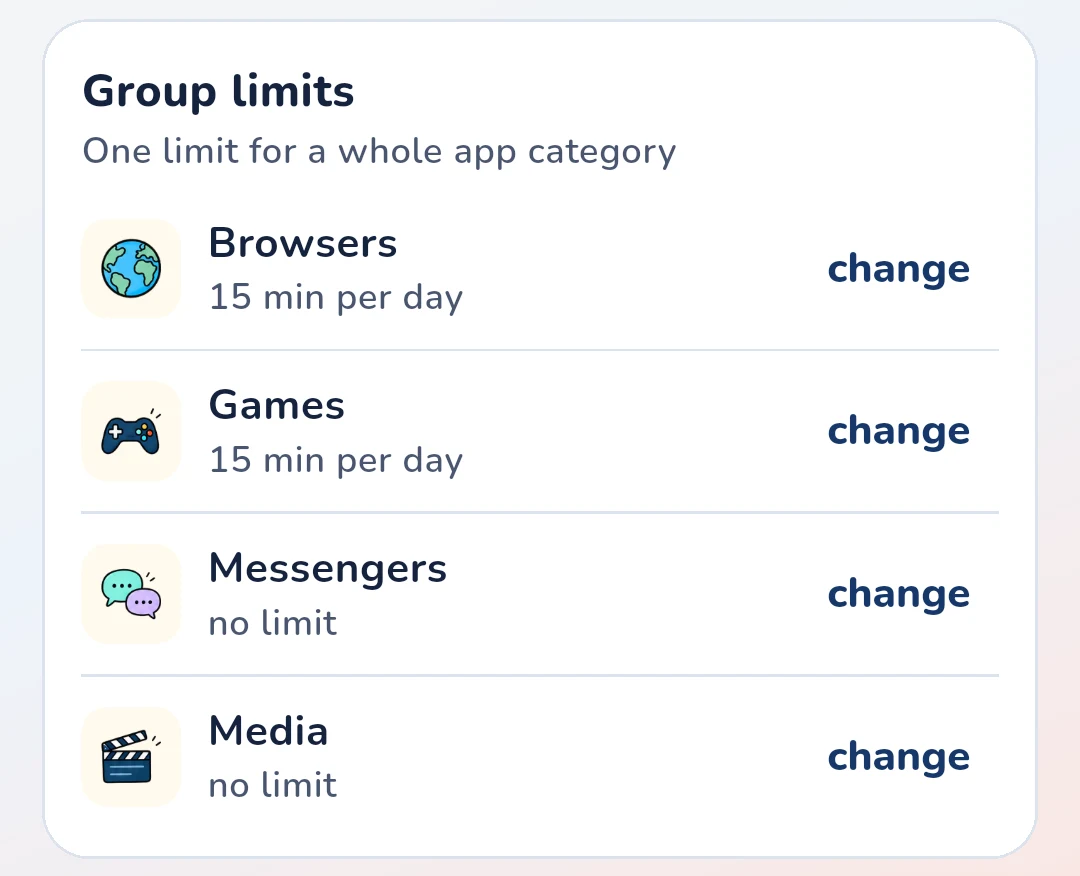
Group limits. The App limits section has a card with four groups: Browsers, Games, Messengers and Media. Video and music apps fall under Media, and one limit applies to every app in that category. If a single app is the problem, you can set a limit for just that app.
Time requests. When time runs out, your teen can ask for more. The request shows up in the parent app with two buttons: Give +15 and Reject. Stopping turns into a short exchange: they ask, you answer.
Bedtime. A schedule locks the phone for the night, so there's nothing to scroll in bed.
To see how much screen time makes sense at your teen's age, try our screen time calculator. To get started on your child's phone, see parental controls for Android.
Some evening, a "+15 min" request for a video app will pop up on your phone. That's the stopping point the feed never had.
Sources
Links checked October 18, 2026.
European Commission: Commission preliminarily finds TikTok's addictive design in breach of the Digital Services Act, February 6, 2026.
U.S. Surgeon General: Social Media and Youth Mental Health, 2023.
Li Q., Yin X.: Doomscrolling, mental health, and psychological well-being in adolescents and adults: a systematic review and meta-analysis, Frontiers in Psychology, 2026.
Akat M., Hamarta E.: Doomscrolling and social media addiction in adolescents: a two-wave longitudinal study, Journal of Addictive Diseases, 2025.
Tan D., Zhang R., Yang L.: A longitudinal network analysis of parental responses to adolescents' negative emotions and adolescent social media doomscrolling, Applied Psychology: Health and Well-Being, 2026.
Candice L. Odgers: The great rewiring, Nature, March 29, 2024.
YouTube Help: Turn autoplay on or off and Take a break reminders.
American Academy of Pediatrics: How to Make a Family Media Use Plan, 2026.
In short
Repeatedly scrolling through bad news and upsetting content for long stretches while finding it hard to stop. The word combines "doom" and "scroll."
There's no solid evidence that it damages the brain. Studies link doomscrolling to anxiety and low mood but can't say which is the cause and which is the effect. The idea that it overstimulates the reward system is still a hypothesis.
Turn off autoplay, switch on break reminders, silence notifications from feeds, give the feed a set time, and put the phone away an hour before bed.
Doomscrolling is about what a person reads and whether they can stop. Problematic social media use is broader. In a study of Turkish teens, social media addiction came before doomscrolling.
Not as a first step. In a study of nearly 3,000 teens, parents punishing a teen's bad mood went along with stronger withdrawal from the feed. Agree on a time and settings instead, and set a limit your teen knows about.
Set limits in 3 minutes
Limits, schedule and anti-bypass protection on Windows and Android. 14 days of full access, no card needed.
Try GardionOr install the parent app now.
Read next
- Phones before bed: how screens affect kids' and teens' sleepWhy phones before bed hurt kids' sleep more than adults': three ways screens interfere, how much sleep each age needs, and a screen-free last hour.
- Alternatives to screen time for kids: what to offer at the hours they reach for the phoneScreen-free activities for kids, matched to the hours they reach for the phone: a one-week plan, ideas by age, and what to do instead of screens before bed.
- Gaming disorder in teens: what the ICD-11 diagnosis 6C51 meansGaming disorder in ICD-11: the three criteria for 6C51, the 12-month rule, how it differs from DSM-5-TR, the ICD-10 code, and when to see a doctor.
- Digital detox for teens and families: does it work and how to plan oneDoes a digital detox help teens? What screen-break studies found, which format fits your family, how to prepare, and what to keep afterward.