 Gardion
Short attention span in kids: are short videos to blame?

Many parents worry that TikTok, Reels and Shorts have shrunk their child's attention span. Labels like "TikTok brain" make good headlines, but no diagnosis goes by that name, and psychologists don't measure a single attention span for everyone. What researchers do study is attention, self-control and media multitasking. Kids and adults who watch more short-form video tend to score lower on attention and impulse control. Whether the videos cause that, or distractible people simply scroll more, the research can't yet say. Below we look at where the worry came from, which famous number about attention turned out to be made up, what studies actually show, and what to do at home when your child can't finish a chapter. Whether "phone addiction" is a real thing is a separate question, and we cover it in our main guide to phone addiction in kids.
Where the worry comes from
The fear is older than smartphones. In his 1980 book The Third Wave, futurist Alvin Toffler described "blip culture": people taking in the world as fragments, such as a 90-second news item, an ad, a few bars of a song, a headline, a cartoon. He was writing about TV and magazines. Toffler didn't treat this as a disaster. He argued that a new kind of person was learning to put the fragments together into a picture of their own.
Today the same worry comes with new names, and none of them is a clinical term. When a teacher says your son "can't focus anymore," that's an observation, and it may well be accurate. It helps to describe it in concrete terms: he stops halfway through reading, he checks his phone during homework, he loses interest in anything slow.
The goldfish myth: where the 8 seconds came from
The best-known claim about attention goes like this: humans now focus for eight seconds, less than a goldfish. Newspapers around the world repeated it. In 2017, the BBC radio program More or Less traced the number. It appeared in a 2015 Microsoft Canada report, but Microsoft hadn't measured it. The figure came from a website called Statistic Brain, and the organizations that site cited couldn't find any such study.
Gemma Briggs, a psychologist at the Open University, told the BBC that psychologists don't measure an "average attention span" at all, because attention depends on the task. A child who can't stick with math problems for five minutes may happily build Lego for an hour. The goldfish was treated unfairly too: scientists have used goldfish for decades to study memory and learning.
What research shows about short videos and attention
Studies on short-form video have multiplied in the last few years, and the overall picture is cautious.
The largest review so far appeared in Psychological Bulletin in 2025. The authors pooled 71 studies of children, teens and adults. People who watched more short videos had weaker attention and inhibitory control, meaning the ability to stop an impulse. The link was moderate and looked the same for young people and adults. Still, nearly all the studies took a single snapshot in time, and many relied on people rating their own attention in a questionnaire. So the arrow could point the other way: someone who already struggles to focus may find scrolling easier.
Here's how we read it. The idea that phones "rewire kids' brains" isn't supported: the ABCD researchers found no changes in brain organization over two years that they could pin on screens. A lot of video watching does tend to go along with distractibility, though. With preschoolers, fast-paced content also knocks self-control off balance right away. Since nobody can name the cause yet, changing habits at home makes more sense than hunting for a diagnosis. The debate over social media is even louder, and we lay out the arguments in social media and teen anxiety: what research says.
| What was studied | What researchers found | What it doesn't prove |
|---|---|---|
| Short videos and attention: review of 71 studies (2025) | Heavier viewers had weaker attention and self-control | That videos damage attention: the link may run in reverse |
| A fast-paced cartoon and 4-year-olds (U.S., 2011) | After nine minutes of a fast cartoon, kids did worse on self-control tasks than after a slow educational show or drawing | That the effect lasts: kids were tested right after watching |
| Media multitasking: several screens at once (2009 and 2018 review) | People who juggle screens all the time were more easily pulled off task by irrelevant details | That it holds for everyone: the later review found many studies showed no difference |
| Digital media and ADHD symptoms in teens 15–16 (JAMA, 2018) | Over two years, symptoms appeared a bit more often among teens who checked social media, games and other apps many times a day | Cause: the authors called the link modest |
| Screens and the brains of kids 9–12 (ABCD Study, 2023) | Screen use didn't change how the brain matured over two years | That screens are harmless for attention: researchers looked at the brain at rest |
Normal distraction or an attention problem?
Compare how your child handles something they love and something boring. Maybe they can spend hours building, drawing or reading about dinosaurs, yet give up on a spelling worksheet after five minutes. That's how attention works for most kids: interesting things hold it, dull ones take effort. When boring tasks feel even more boring after videos, people often blame a "dopamine crash." What neuroscience says about that is in our guide to dopamine and screens.
It's different when your child can't concentrate anywhere, even on favorite activities, and it gets in the way of school and friendships. Then it's worth seeing a pediatrician or a child psychologist. The CDC notes that ADHD has to be diagnosed by a professional and that sleep problems, anxiety and depression can look similar. If your child regularly falls asleep after midnight, start with sleep: our article on phones before bed explains how to change the evening routine.
If the trouble focusing comes with tears, new fears or refusing to go to school, bring it up with your pediatrician soon. If your child ever talks about not wanting to live, call or text 988 to reach the Suicide & Crisis Lifeline.
What to do at home
- Give your child one long activity every day: a chapter read aloud, a whole movie, a board game played to the end. Pick something they actually like, because that makes it easier to stay with it.
- Choose slower shows for young kids. In the 2011 experiment, a fast cartoon with rapid scene changes threw off self-control, and a calm educational show didn't.
- Keep the phone off the desk during homework. Put it in another room with notifications off, since every message pulls attention to a second screen.
- Cap time on Shorts. Since January 2026, YouTube lets parents of teens with supervised accounts set how long they can scroll Shorts, and the company has said a zero-minute option is coming for homework time.
- Turn off autoplay. We showed where that setting lives in YouTube in our guide to doomscrolling in teens. In 2026, the American Academy of Pediatrics asked platforms not to start the next video for kids automatically.
- Offer something to do in place of videos. Our list of things to do instead of the phone has ideas for a screen-free evening.
Setting a limit on videos in Gardion
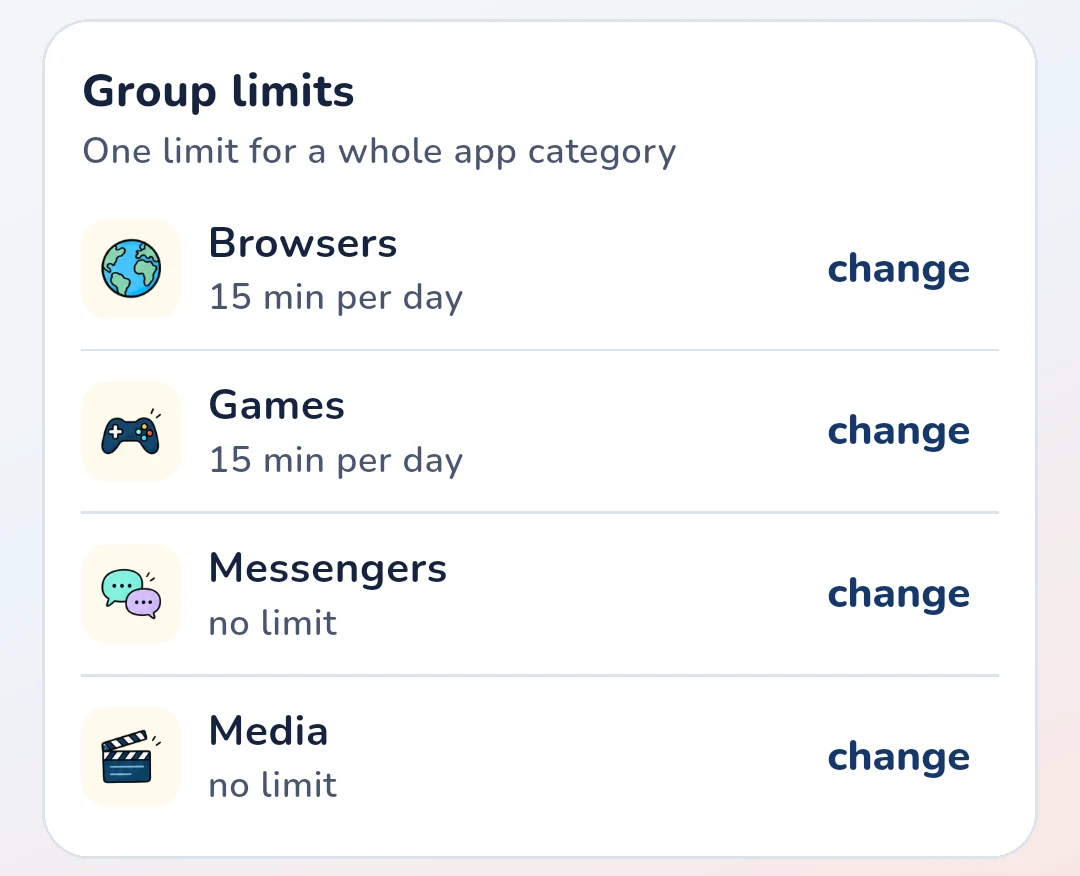
In Gardion, our parental control app, video and music apps sit in the Media group. In the App limits section, you set one daily limit for the whole group. If your child keeps going back to one particular app, you can limit just that app. When the time is up, your child can send a request for more minutes, and you choose Give +15 or Reject in the parent app.
For age-based guidelines from the AAP and the WHO, see our screen time calculator. To set Gardion up on your child's phone, go to parental controls for Android.
Toffler hoped people would learn to piece fragments together on their own. At home, a bedtime chapter read all the way to the end is good practice.
Sources
Links checked October 19, 2026.
Alvin Toffler: The Third Wave, 1980, chapter 13, "Blip Culture."
BBC News: Busting the attention span myth, March 10, 2017.
Nguyen L. et al.: Feeds, feelings, and focus: A systematic review and meta-analysis examining the cognitive and mental health correlates of short-form video use, Psychological Bulletin, 2025.
Lillard A., Peterson J.: The immediate impact of different types of television on young children's executive function, Pediatrics, 2011.
Ophir E., Nass C., Wagner A.: Cognitive control in media multitaskers, PNAS, 2009; Uncapher M., Wagner A.: Minds and brains of media multitaskers, PNAS, 2018.
Ra C. et al.: Association of Digital Media Use With Subsequent Symptoms of ADHD Among Adolescents, JAMA, 2018.
Miller J. et al.: Impact of digital screen media activity on functional brain organization in late childhood: Evidence from the ABCD study, Cortex, 2023.
YouTube Official Blog: New parental controls for teens, January 14, 2026.
CDC: Diagnosing ADHD.
American Academy of Pediatrics: Creating a child-friendly digital world, January 20, 2026.
988 Suicide & Crisis Lifeline: 988lifeline.org.
In short
Studies find a link: kids and adults who watch more short videos tend to have weaker attention and self-control. Nobody has shown that the videos are the cause. In young children, a fast-paced cartoon lowers self-control right after watching.
It's a media label, not a diagnosis or a measured condition. Your child's trouble focusing can still be real, and it's more useful to describe it in concrete terms.
Yes. The eight-second figure came from a website with no study behind it, and psychologists say attention depends on the task.
Give them one long activity every day, keep the phone away during homework, cap time on Shorts and turn off autoplay.
When your child can't focus on anything, even favorite activities, and it affects school and friendships. ADHD, poor sleep and anxiety can look alike, and a pediatrician or child psychologist can sort them out.
Set limits in 3 minutes
Limits, schedule and anti-bypass protection on Windows and Android. 14 days of full access, no card needed.
Try GardionOr install the parent app now.
Read next
- Social media and teen anxiety: what the research says and what parents can doDoes social media cause anxiety in teens? Haidt's case, his critics' reply, what both sides agree on about self-esteem and sleep, and what parents can do now.
- Dopamine and screens: is your kid's phone really draining their dopamine?Does screen time drain kids' dopamine? What neuroscience says, why kids melt down when the screen goes off, and whether a dopamine detox helps.
- Phones before bed: how screens affect kids' and teens' sleepWhy phones before bed hurt kids' sleep more than adults': three ways screens interfere, how much sleep each age needs, and a screen-free last hour.
- Doomscrolling in teens: why the feed is so hard to put down and what helpsWhat doomscrolling is, why teens find the feed so hard to put down, what research says about the brain and mood, and what teens and parents can do.